
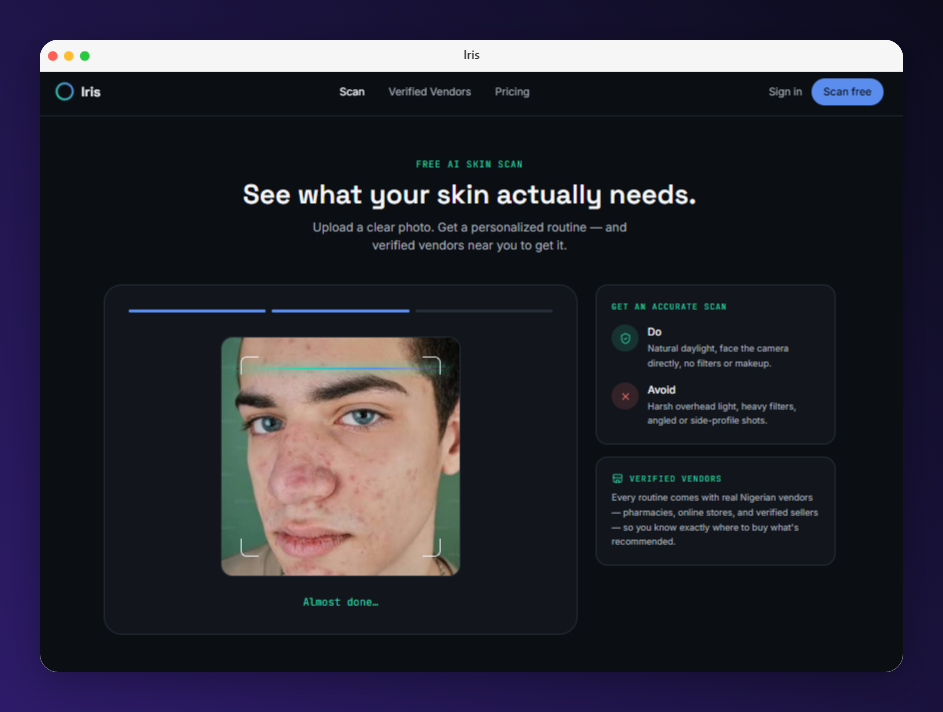
Over the past few weeks, I've been quietly building something new. It's called Iris - an AI Skin Intelligence platform designed to help people understand their skin, receive personalized skincare recommendations, and discover trusted places to buy the products they actually need.
It's still very much a work in progress, but I wanted to start documenting the journey publicly - the wins, the bugs, the architecture decisions, and everything in between.
"Some of the best products aren't built in secret. They're built in public."
💡 Why I Started Building Iris
Skincare has become overwhelming.
Scroll through TikTok, Instagram or YouTube and you'll find hundreds of people recommending products that may or may not work for your skin.
The problem isn't the lack of information.
It's having too much information without knowing what's actually relevant to your skin.
Most people simply want answers to questions like:
- What skin concerns do I actually have?
- Which ingredients should I look for?
- What routine should I follow?
- Where can I buy genuine skincare products?
Iris is my attempt at solving those questions with AI.
How Iris Works
I wanted the experience to feel incredibly simple.
- Upload a clear selfie.
- AI analyzes visible skin characteristics.
- Generate a personalized skincare routine.
- Recommend products by ingredients—not brands.
- Connect users with verified Nigerian skincare vendors.
"You have dry skin."
It's to say:"Here's what your skin needs, why it needs it, and where you can actually get the products."
Building Beyond AI
One thing I wanted to avoid was creating another chatbot wrapped around an API.
I'm spending just as much time designing the experience as I am building the intelligence behind it.
- Beautiful health-focused UI
- Smooth scan animations
- Privacy-first image handling
- Human-friendly explanations
- Fast responses
- Ingredient-first recommendations
Great AI products aren't just intelligent.
They're trustworthy.
Behind the Scenes
Under the hood, Iris combines AI vision with structured recommendation logic.
Instead of pushing random skincare brands, it focuses on ingredients first before matching recommendations with trusted vendors.
Building it has been incredibly fun - but not without challenges.
- Making AI responses consistent
- Handling malformed JSON responses
- Designing reliable fallback systems
- Improving scan accuracy
- Keeping everything responsive and fast
Every time I solve one problem, I discover two more.
That's honestly my favorite part of building software.
What's Next?
Iris is nowhere near finished.
I'm currently working on:
- Higher-quality AI analysis
- Progress tracking over time
- Smarter recommendations
- More skincare education
- A much more polished interface
- Even better user experience
Building products in public keeps me accountable, helps me learn faster, and opens the door to valuable feedback.
💬 Let's Build Together
I'll continue sharing updates as Iris evolves - from design decisions and engineering challenges to lessons learned and launch milestones.
If you're interested in AI, software engineering, startups, or product design, I hope you'll follow along.
If you could add one feature to an AI skincare assistant, what would it be?
Drop your thoughts in the comments 👇



Charity
You're really doing a nice work
Keep it up 💪🏾💯
Jul 21, 2026 · 12:32 AM
Adeagbo Tomiwa
AdminThank you so much charity!
Jul 28, 2026 · 8:31 AM
David
Keep up the good work man, we gat you
Jul 21, 2026 · 11:06 AM
Adeagbo Tomiwa
AdminThank you so much David!
Jul 28, 2026 · 8:31 AM