
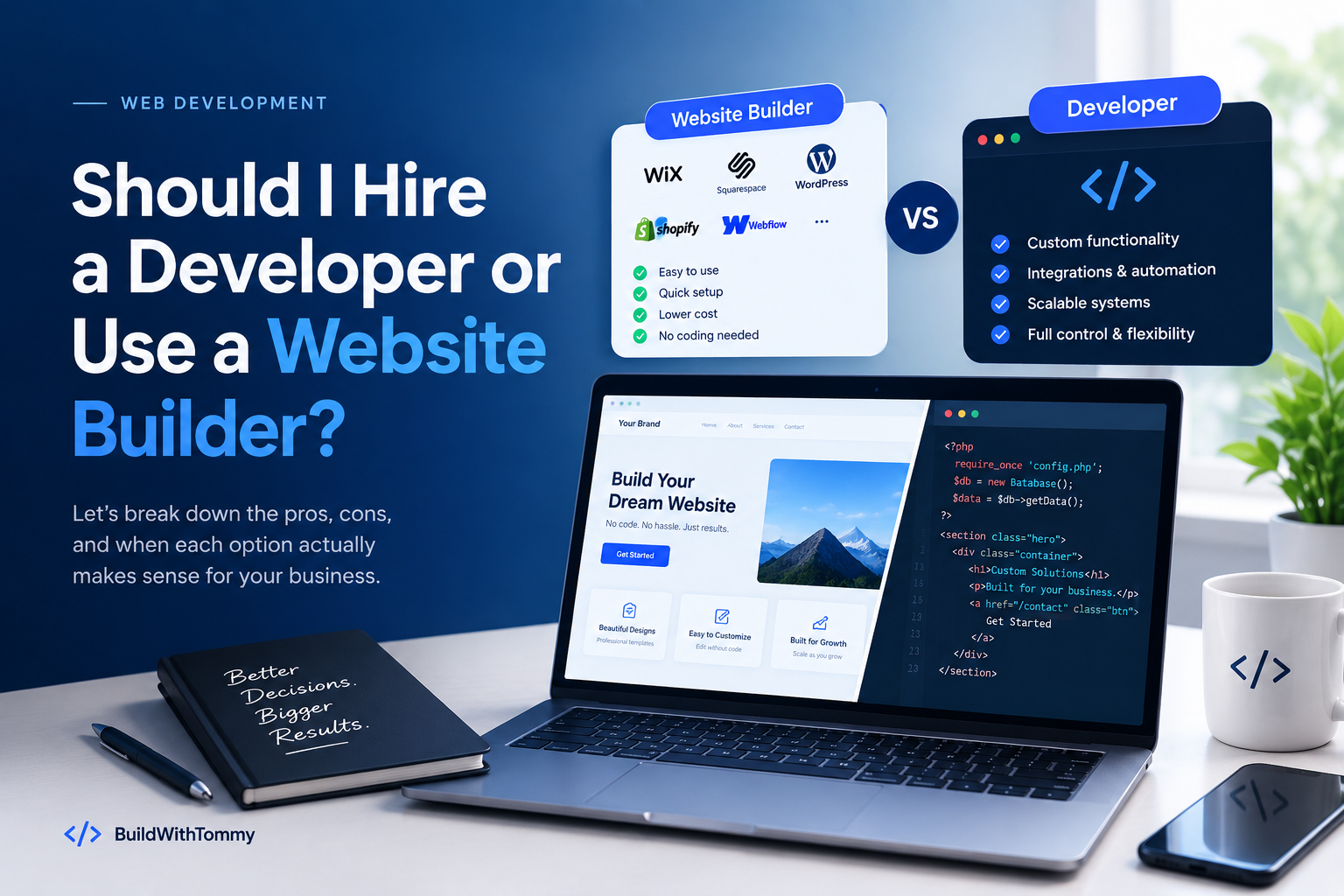
Should I Hire a Developer or Use a Website Builder?
If you're planning to build a website for your business, you've probably come across platforms like Wix, Squarespace, WordPress, Shopify, Webflow, and other website builders. They're easier to use than ever, and with AI becoming part of many of these platforms, you can now create something that looks pretty good without writing a single line of code.
So the question becomes - do you really need to hire a developer?
The honest answer is: it depends on what you're trying to build.
If you need a simple website to put your business online, a website builder might be all you need. But if your website needs to do something specific, connect to other systems, automate part of your business, or grow into a larger platform, that's where working with a developer starts to make more sense.
What Is a Website Builder?
A website builder is a platform that gives you pre-built tools and components for creating a website without having to build everything from scratch. You can usually choose a template, edit the content, add images, change colours, create pages, and publish the website without knowing how to code.
Platforms like Wix, Squarespace, Webflow, and similar tools have made it much easier for individuals and small businesses to get online quickly.
And that's a good thing.
Not every business needs a custom-built website.
When a Website Builder Makes Sense
If you're just starting out and your main goal is to establish an online presence, using a website builder can be a smart decision.
For example, if you run a small consulting business and simply need a homepage, about page, services page, contact form, and maybe a blog, you probably don't need to spend a lot of money building a custom system.
- You need a simple business website
- You want to launch quickly
- You have a limited budget
- You don't need complicated functionality
- You are comfortable managing the website yourself
- Your business can work with the platform's existing features
In situations like these, a website builder can save you time and money.
But Website Builders Have Limitations
The problem usually starts when your requirements become more specific.
Website builders are designed to serve a large number of businesses, so they provide features that work for common use cases. But your business may have a workflow that doesn't fit neatly into those features.
You might need a custom customer dashboard, a unique booking system, an internal management platform, a custom payment workflow, or an integration with another system your business already uses.
At that point, you may find yourself trying to force a platform to do something it wasn't designed to do.
What Does a Developer Actually Give You?
When you hire a developer, you're not just paying someone to write code.
You're paying for someone who can understand your requirements, plan the system, choose the right technologies, build the functionality, connect different services, test everything, and continue improving the platform as your business grows.
A developer can build something specifically around your business instead of asking your business to fit into the limitations of a platform.
- Custom functionality
- Custom database systems
- Custom dashboards
- API integrations
- Business automation
- Advanced user authentication
- Custom payment workflows
- Scalable web applications
Custom Doesn't Always Mean Better
This is something I think is important to say as a developer.
Just because something can be custom-built doesn't mean it should be.
If you only need a simple five-page website, building a completely custom platform could be unnecessary. You could end up spending more money and time solving problems that a website builder already solved for you.
The goal shouldn't be to build everything from scratch.
The goal should be to choose the solution that makes the most sense for your business.
Think About What Your Website Needs to Do
One of the easiest ways to decide between a website builder and a developer is to stop thinking about how the website should look and start thinking about what it needs to do.
Ask yourself what happens after someone visits your website.
Do they simply read information and contact you?
Or do they need to create an account, make a payment, book a service, upload documents, track an order, communicate with other users, or interact with an automated system?
The more complex the answer becomes, the more likely you are moving beyond what a basic website builder is designed for.
What About WordPress?
WordPress sits somewhere in the middle.
You can use WordPress with a ready-made theme and plugins to build a website without much technical knowledge. At the same time, developers can customize WordPress extensively and build custom themes, plugins, integrations, and functionality around it.
This makes it a flexible option for many businesses.
But even with WordPress, adding too many plugins or trying to force unrelated systems together can eventually create maintenance, security, and performance problems.
What About AI Website Builders?
AI has made the decision even more interesting.
Today, you can describe the website you want and AI can generate layouts, write content, create code, and even help you deploy a working project.
For prototypes and simple websites, this can be incredibly useful.
But AI doesn't automatically remove the need for technical knowledge. Someone still needs to understand the generated code, verify that the application is secure, test the functionality, handle edge cases, and make sure the final product actually solves the business problem.
AI makes building software faster. It doesn't make good planning unnecessary.
Website Builder vs Developer
There isn't one option that's right for everyone.
- Website builder: Better for simple websites, quick launches, and smaller budgets.
- Developer: Better for custom functionality, integrations, automation, and complex systems.
- AI tools: Great for speeding up development, prototyping, and generating ideas.
- Hybrid approach: Often the best option when you want to use existing tools while adding custom functionality where necessary.
Don't Choose Based Only on Price
It's tempting to choose whichever option is cheapest, especially when you're just starting a business.
But the cheapest option isn't always the one that costs you the least in the long run.
If your website becomes difficult to maintain, can't support new features, loads slowly, or prevents you from automating important parts of your business, you may eventually have to rebuild it anyway.
At the same time, spending thousands of dollars on a custom website when a simple website builder would have done the job isn't necessarily a good investment either.
It's about finding the right balance between your current needs, your budget, and where you expect the business to go.
So, Should You Hire a Developer?
If you only need a simple website to introduce your business to the internet, you probably don't need one.
But if your website is going to become an important part of how your business operates, a developer can make a huge difference.
If you need custom features, integrations, automation, customer accounts, payments, dashboards, or a platform that needs to scale, that's when professional development becomes much more valuable.
Final Thoughts
You don't need to hire a developer just because you want a website.
You hire a developer when the problem you're trying to solve requires more than what a standard website builder can reasonably provide.
Website builders are great. Developers are great. AI tools are great too.
The important thing is knowing which tool is right for the problem you're trying to solve.
Don't build a custom system just because you can, and don't squeeze your business into a template just because it's cheaper.
Start with what your business actually needs, then choose the technology that can support it.
Need Help Deciding What You Actually Need?
If you're not sure whether your project needs a website builder, a custom website, or a full web application, I can help you figure that out before you start spending money on development.
The goal isn't to sell you the most complicated solution. It's to build the right solution for your business, your users, and your budget.

No comments yet — be the first to share your thoughts.